

What are O*NET Fields?
The Occupational Information Network (O*NET) is a comprehensive taxonomy created by the US Dept of Labor used to standardize job titles into a structured hierarchy. These fields allow you to group and analyze professionals based on their functional roles rather than just their raw (and often messy) job titles. The current version maintained by the US Dept of Labor is the O*NET-SOC 2019 Taxonomy, which is the one we represent in our O*NET related fields.The O*NET Code
With the O_NET system, every job title is assigned a 6-digit O_NET code which represents its classification in the taxonomy. For example, the code11-1011.03 is assigned to job titles related to Chief Sustainability Officer roles.
O*NET codes are structured as follows:
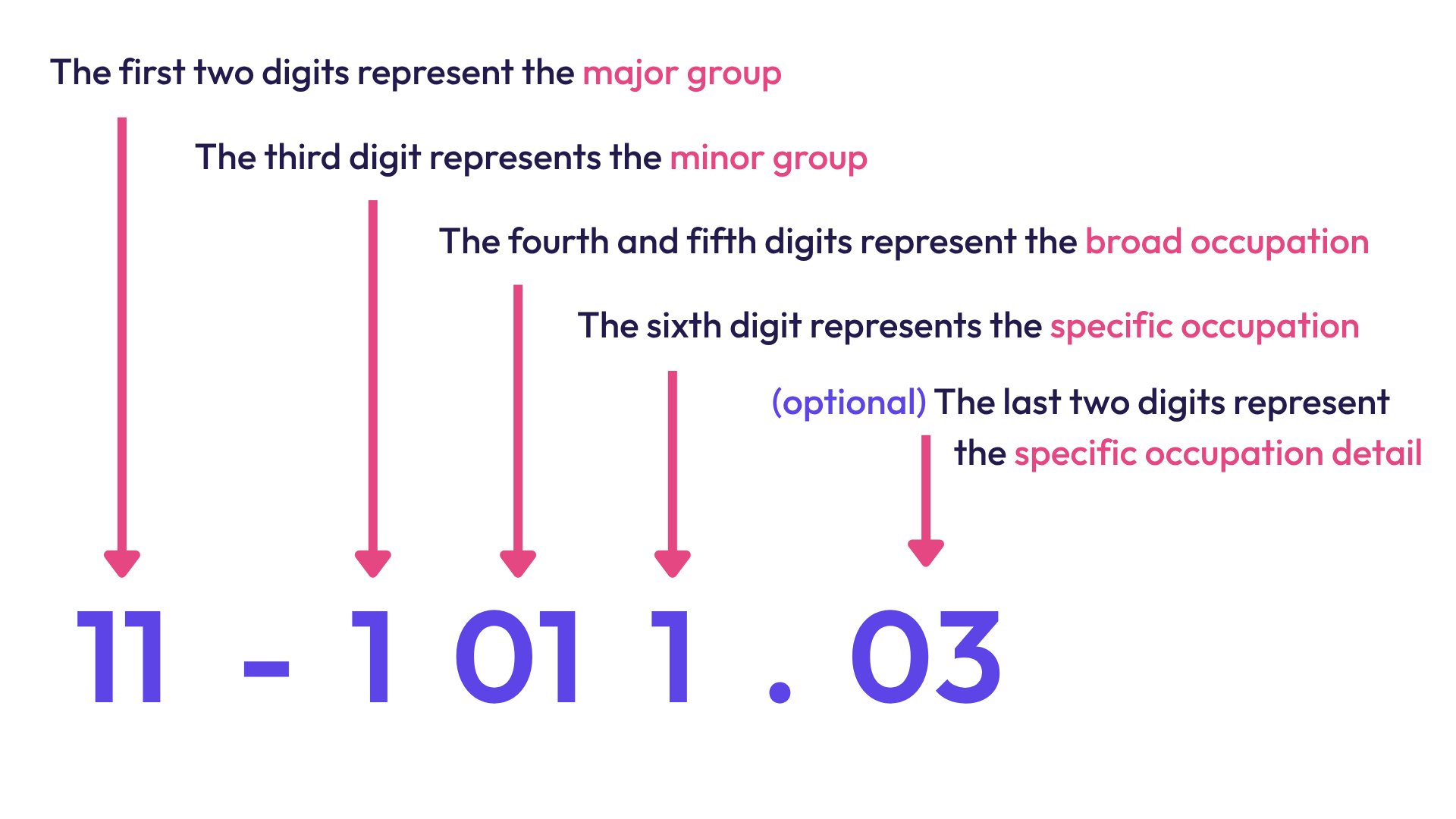
Taxonomy Structure
The O*NET system assigns each job title a classification with 4 hierarchical categories:- Major Group: The broadest category. Groups occupations into 23 very large clusters, such as “Computer and Mathematical Occupations” or “Sales and Related Occupations.” Best for high-level labor market analysis.
- Minor Group: The second level of the hierarchy. Provides more specific categorization within a Major Group. For example, within “Computer Occupations,” this would distinguish between “Database and Network Architects” and “Software Developers.”
- Broad Occupation: The third level of the hierarchy. This groups several specific occupations that require similar skills and duties. It’s the “middle ground” for grouping people with comparable professional backgrounds.
- Specific Occupation: The standard functional role. This is the most commonly used level of the O*NET taxonomy. It maps a person’s job to a standardized title (e.g., “Software Quality Assurance Analysts and Testers”) to ensure consistent reporting across different companies
- Specific Occupation Detail: An optional additional level of classification below Specific Occupation. This used to further distinguish roles that fall within a Specific Occupational category (e.g., Chief Technology Officer as the Detailed classification within the Chief Executives Specific Occupation classification).
Example
For the above example ofChief Sustainability Officer roles (11-1011.03), this breaks down as follows: